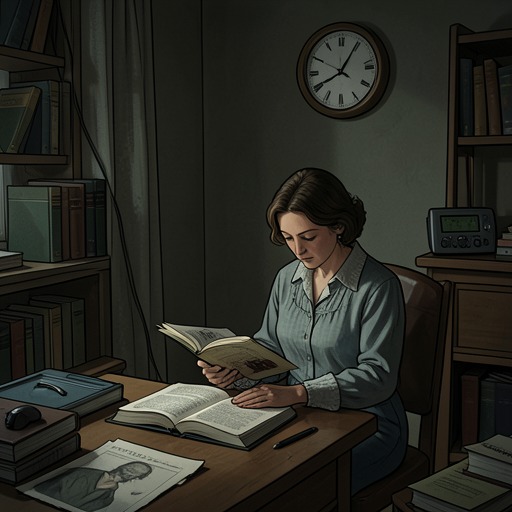
Bénédicte meets Christian by the forest and begins an affair
L'Amour et les ForêtsBénédicte meets Christian by the forest and begins an affair on March 9, 2006, in an afternoon that turns a clandestine visit into a decisive emotional and physical awakening. Archery, a kiss, and hours together at Christian’s home draw Bénédicte out of the guarded life she has brought with her, while the memory of the day will continue to shape her long after it ends.
The Arrival and First Meeting
Bénédicte follows Christian’s clear directions and reaches his home at about a quarter to one. The weather is magnificent. Though it is only March 9, the radiant landscape gives her the feeling that spring, and a much larger span of promised days, surrounds her. The present seems to open into an imagined future of brightness and tenderness. She wonders whether the meeting ahead might become a lasting relationship, although she cannot know what the day will bring.
At the door, she rings the bell and waits, recalling childhood mischief and her father’s punishments for her impulsiveness. She even tries to reassure herself that Christian will not appeal to her. Instead, he comes up behind her: a solid, reassuring, brown-haired man with short hair, wearing gardening gloves and carrying pruning shears, which he sets down in the grass. His face differs from the photograph she has seen, and she finds him more attractive in person. Their first greeting is awkward enough that they joke about their mutual shyness before settling on a kiss on the cheek. His smile, marked by deep dimples, immediately unsettles her composure.
What strikes Bénédicte is not only that she desires him, but that he seems to meet her without appraising her body. He is cordial and cheerful, appearing to enjoy her company without covertly assessing her erotic appeal. She, by contrast, studies his features and details—his hands, teeth, skin, hair, and other physical particulars—and repeatedly arrives at the same conclusion: she is powerfully attracted to him. The difference between being examined and being welcomed gives the encounter an ease she has not expected.
Archery and the Bull’s-Eye
Christian eventually suggests that they try archery rather than continue talking about his work in antiques. He hands Bénédicte a traditional wooden longbow, about two metres across, its surface covered with python skin by an artisan saddler. Although the bow looks delicate to her, Christian explains that its thirty-three-pound draw gives it enough force to kill large game at a distance. Their exchange turns the weapon into both a practical object and a playful counterpoint to her romantic idea of Cupid’s bow.
Before they go to the garden, Christian fastens a rigid leather bracer around Bénédicte’s left wrist to protect it from the bowstring. He explains that the string can cut a person if the bow is not properly aligned; the bracer, too, has been made by his saddler friend. Bénédicte notices the care and refinement in the equipment, and the close, methodical adjustment of the laces sends a physical thrill through her arm.
Behind the barn, Christian sets up a target made years earlier by his son. Five numbered, concentric rings are painted on a large rectangular board. The garden has grown warmer; the grass is vivid and soft under Bénédicte’s boots, birds call from the trees, and the dark mass of the forest curves around the edge of the garden. Christian teaches her how to stand, place her feet, set the arrow against a mark on the string, keep both eyes open, and release with her fingertips without adding an extra impulse. He demonstrates by shooting several arrows.
When her first efforts do not satisfy him, Christian urges her to give the shot a purpose. He suggests imagining that her children have gone hungry and that she must bring meat home. Bénédicte takes the instruction seriously and, thinking of her hungry children, sends an arrow into the target. The lesson sharpens the contrast already inside her: she is a mother with a home and obligations, but she is also standing in a garden with a man she wants. As the afternoon continues, she still cannot decide whether to make love to him or leave before she crosses that line.
She sets herself a test: if the next arrow does not land in the red, she will gather her things and go. The shot misses the precise spot she aimed for by about twenty centimetres, yet lands deeply and cleanly in the center of the target. Christian celebrates her achievement as an astonishing bull’s-eye for a beginner after so few attempts. He embraces her and turns with her in his arms. Bénédicte laughs, then admits that she had meant to hit the red and calls the result bad luck. Christian rejects chance as an explanation. He suggests that, beneath her conscious aim, she meant to reach the center—to choose the absolute and the beautiful—and treats the arrow as evidence that their meeting has a deeper necessity. His interpretation transforms a miss into a sign of their attraction.
The Kiss and the Forest
Bénédicte is captivated by Christian’s reading of the shot and agrees with him. He kisses her, and the kiss lasts a long time. Its immediacy astonishes her: for many years no man has kissed her with such attention. The kisses exchanged with her husband have been routine pecks, morning and evening, rather than a way of delighting in one another. Christian’s kiss is at once tender, hungry, serious, and desirous. Bénédicte eventually breaks it off, smiling with a happiness she can no longer control. Her thoughts, expression, and bodily reactions seem to have escaped her command.
At 3:10, she proposes that they go into the forest. During their walk a roe deer appears between the trunks, watches them, and bounds away. Christian and Bénédicte hold each other around the waist, stop often to kiss, and sometimes put their hands together. The joined hands trouble her in a way the kisses do not: she thinks of herself as a married woman and mother, and feels that allowing Christian to hold her hand could offer him a promise she cannot make. She prefers to be held around the waist. The distinction reveals how sharply the encounter divides physical desire from the obligations and identity she carries into it.
Christian leads her to his favourite tree, a monumental oak with long, spreading branches and blue flowers growing beneath it. He jokes that he might place a bench there to read and write poems in summer, and that Bénédicte will become their heroine. They kiss again. She touches the back of his neck and responds to his smell and taste, but when he puts his hands under her dress she pulls away. Christian apologizes, recognizing that he has misread the moment; Bénédicte answers by taking the blame herself. Their retreat from that first escalation does not end the encounter. It makes clear that her willingness is unfolding by stages, rather than following automatically from the force of her desire.
The Affair Begins
At 4:05, Bénédicte suggests they return to Christian’s home before it gets too late. There they make love twice. In the spacious bedroom, furnished with the same refinement as the living room, she lets Christian undress her without fearing that he will find her unattractive, while she eagerly undresses him. Their intimacy includes laughter, moans, food, breathless pauses, and declarations whose sincerity will later make them painful to remember. Christian gives her time and space to regain confidence and experience pleasure without pressure, an attentiveness that contrasts with the routine and deprivation of intimacy in her marriage.
The bedroom’s objects become part of the memory she carries away. A dark seventeenth-century portrait of an ecclesiastic hangs above a dresser holding a bronze nude, perfume bottles, and a clock. Its hands remind Bénédicte of the arrows she has shot. At 6:10, she notices the time and makes a private ritual of it: from then on, each day at that hour she will try to look at the hands of her watch and think of Christian, the severe ecclesiastic in the portrait, and their naked bodies reflected apart in the mirror. The clock fixes the afternoon to a precise, recurring moment, turning an episode into something she will deliberately revisit.
The affair begins not with a settled plan but through a series of choices that repeatedly bring Bénédicte closer to Christian: following the directions to his home, accepting the bow, staying after the shot, agreeing to the kiss, walking into the forest, and finally returning to the bedroom. The bull’s-eye provides Christian with a story of fate; the remembered hour provides Bénédicte with a way to preserve the day. Her pleasure and her awareness of risk coexist. What becomes a source of joy in the moment will also become, through the sincerity of their words and the force of her recollection, a wound that obsesses her for months.